Over the last month, one project I have been working on are posters for several prevention campaigns. These posters will be distributed to companies that are members of Expoflores, the Association of the Producers and Exporters of Flowers in Ecuador.
Companies are required, by the government, to educate their employees through workshops and graphic material about various prevention campaigns. The workshops are typically provided by a variety of professionals including: government institutions that are invited to farms, the Area of Social Responsibility of Expoflores, medical and psychology professionals. In addition to these workshops, the farms must provide graphic information visibly posted around the farm. Typically they will find their graphics using a google search and make posters in word processing programs.
The Area of Social Responsibility at Expoflores, who I have been volunteering with, saw this as an opportunity to create better graphics to promote the campaigns at their member farms. Good design draws more attention and therefore is more likely to serve the purpose of posting information about the campaigns. In the case of these campaigns, we hope these graphics will catch the employee’s attention and support important discussions on topics that are incredibly relevant to workers lives.
In creating these campaign posters I have also learned a lot about the current status of these topics in Ecuador. There is a long way to go before they – and for that matter most countries – reach proper awareness and education on these subjects, but it’s hopeful to see that people are willing to talk about issues instead of ignoring them.
The topics of these prevention campaigns are: alcohol consumption, smoking, sex ed, gender & psychological violence and HIV-Aids.
PREVENTION CAMPAIGN POSTERS
Created by: Heather A Rule
in collaboration with Viviana Díaz, José Luis Goyes and Cristina Parra
from the Area of Social Responsibility at Expoflores
One year ago today, on April 16th, 2016 the coast of Ecuador was hit by a devastating, 7.8 on the Richter scale, earthquake. The earthquake that shook the land and caused tremendous damage also brought together a nation. The people of Ecuador, both those living in the country and those abroad, banded together in support of those who were affected by this disaster. Those in the country gathered food, water and supplies and got them to those affected. People, both in and out of the country, raised funds to help with the disaster relief and later the rebuilding efforts.
When the earthquake happened I was living in Austin and through that difficult time, the Ecuadorians in Austin, came together and did what they could. We supported one another and organized various fundraising efforts in Austin.
Coming together with our fellow Ecuadorians at the Texas State Capitol to create awareness.
Fundraising at the Saturday Farmer’s Market in Austin.
Young Ecuadorians in Austin.
Mural for Ecuador.
Austin Fundraiser for the earthquake victims.
Working at the fundraiser in Austin.
My hope was always that I would be able to participate in some way in the re-construction efforts once I arrived in Ecuador. When an opportunity to travel to the coast with a group from Expoflores for the construction of houses presented itself it was a wish come true! Expoflores is the organization I am volunteering with during my time in Ecuador. After the earthquake, they raised funds from the floriculture industry through a campaign “One Day for Them”. In addition to early disaster relief assistance, these funds were used to build 40 houses in the the area of San Vicente, Manabi.
The following are pictures and accounts of our time in the area of San Vicente this past January 11 and 12, 2017 building houses through the Fundación Hogar de Cristo.
The Area
Salinas de San Vicente is about 20 minutes inland from San Vicente, a town on the water in Ecuador that was severely affected by the earthquake. The main industry in this area is shrimp farming. Did you know that Ecuador is a major shrimp producer and exporter? It is typically one of the top five exports from Ecuador, along with Roses! So this area and the industry that Expoflores represents have a lot in common, in that they are connected to global markets.
For the people in the communities around this shrimp farms, this is a source of employment, but it is not enough employment for all the people living in the community. Many of the men work on fishing boats and the women work as packers at the shrimp farms. With few job options and a very high poverty rate, many of them receive government assistance and have not had the means to re-build on their own.
Shrimp Farm in Salinas de San Vicente.
Sunset on Bahia de Caraquez.
Volunteers from Expoflores!
Rubble, was the evidence left of the destruction caused by the earthquake.
The aid this area received after the earthquake was evident in the build environment. There were wooden and bamboo houses built by the foundation we were working with, Hogar de Cristo and other similar ones by other foundations. There were houses built by MIDUVI (Ministerio de Desarrollo Urbano y Vivienda/Ministry of Urban Development and Housing), although from what we were told these houses were not donated by the government, they are only built and financed through loans from the government. There were also still many of the temporary tents that had been donated by various organizations in the immediate aftermath of the earthquake. We saw tents from the Chinese government, the United Nations Development Program, Samaritan’s Purse and former billboards which had been used to create temporary structures.
As an architect, I was fascinated by how the aid received was so evident and served as propaganda for those who had come to help. It’s easy to be critical of the aid each institution provides, but from hearing the stories of those who had been helped I know they appreciated, beyond measure, the aid they received both in the early days and the aid they were receiving almost a year later.
MIDUVI House
Chinese government tent and former billboard used to create a temporary structure.
Samaritan’s Purse material used to create a temporary worship space.
The Houses
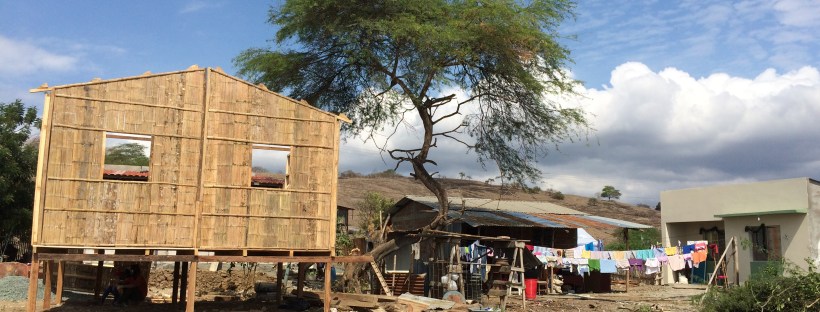
We built 10 houses in 2 days with 9 volunteers and 4 maestros armadores (builders).
These were 10 of the 40 houses the floriculture industry donated the funds to build. The additional 30 houses were build by other volunteer groups through the Hogar de Cristo foundation.
Each house is made of a pre-cut kits of parts that is delivered to the site a couple days before the build day. The kits are prepared in a factory in Ecuador’s largest city and port, Guayaquil, a four hour drive from San Vicente. The houses are each made of a combination of wood and bamboo and cost about $4000. The houses do not have running water and do not include electrical installation, but the families quickly add their own electricity to the structures. The area we were building in does not have potable water.
Johnny digging holes for the columns.
Maestro Ivan nailing down the floor.
Maestro Ivan and Johnny lifting a wall into place.
Johnny placing beams for the roof.
We assembled these house kits between a team of 2-3 volunteers and 1 maestro armador in about 5 hours. On a couple of the houses, someone from the family receiving the donated house, also helped in the assembly process. It is somewhat surprising to see how many people just sit around and watch these houses being built for them.
I’ve always appreciated the term “maestro” used for construction workers here in Ecuador. It translated to “master”, as in the master who can do it all! These construction workers are a jack-of-all-trades and really are masters at their work.
The People
The families receiving these houses lost their homes in the earthquake on April 16, 2016. Each one has their own story of resilience and rebuilding after the disaster. Fortunately, even though most of the structures in this community collapsed in the earthquake, no lives were lost.
The first home my team build was for a family of four. A father, mother and their two sons. Before the earthquake they had a simple wood and bamboo home that collapsed. They used the material of the collapsed house to rebuild a simple structure, but in the after-shocks it collapsed again. You can see the small room they currently live in the the pictures next to the house that we built for their family. One of my favorite moments from the construction of their new house was their request that the entry stair be oriented in the opposite direction. I asked them why this request? This new orientation of the stairs is in the direction of the one room house they re-build using the materials from their collapsed house. They imagine building a roof structure to connect the two where they can place a hammock. A perfect example of agency in the built environment!
New and old.
Family in front of their new house.
Puppies everywhere!
The space where the hammock will eventually go!
View from inside the house.
The second house my team worked on was for an extended family, parents, kids and a couple grandkids, who had lost their large concrete home. On the Saturday of the earthquake, their daughters that were visiting from Quito convinced them all to drive into town for the evening. They had just loaded everyone into the car as the earth began to shake. They sat there and watched their house collapse before their eyes. This outing likely saved some of their lives, as the father recounted how one of the walls collapsed on the bed his daughter and grandchild share.
My favorite moment of building their house was, before the house was even complete, the father installed a hammock under the house and put it to good use. These houses are built 4 or more feet above the ground, creating an accessible, shaded space below the house that is perfect for that hammock!
House walls going up.
A girl and her puppy, on the stairs of their new house.
The Hammock is installed!
Helping hands.
Many helping hands!
Ecuadorians know how to adjust plans on the fly. They have no problem changing directions and creating something new without a plan. If you know me, you know I am a planner. I LOVE having a plan, but learning to not be tied to that plan is a lesson I hope to carry back with me from my time here in Ecuador. Learning to be adaptable can create better places.
Perceptions of Development Work
Development work is as challenging as paid client work. Just because someone is receiving a house for free does not mean that they do not have an opinion to express. These houses are a donation to the recipients. They apply to receive them through the local government in San Vicente to control that families are not receiving multiple homes from non-profits and the government.
In some cases the new owners will have one or two people assist in the build, but many of them just stand around and watch — and they are quality control! Constantly telling those building what to do, how to do and making sure their new house is built according to their desires. On one hand this can be seen like a lack of gratefulness for what they are being given. On the other hand this is their expression of agency. As volunteers we only donate a couple days of our time to help them recover from a devastating disaster. For them this represents hope, permanence and a new beginning so they want to start fresh in the best way possible.
Writing this first blog post, since my arrival in Ecuador, has been persistently postponed. I have been enjoying and absorbing the experience so much that I have a hard time finding the words to share it succinctly in a post. The last three months have been wonderful so it’s past time to share them, even if I cannot find the best words to do them justice.
Despite having lived here for 14 of my growing up years, I have spent the last 14 back in the United States studying and working so being back in Ecuador definitely feels like the cultural exchange that Fulbright is designed to be. It was been wonderful to get a chance to explore Ecuador again with the educational and life perspectives I gained during my time in the northern hemisphere!
The lesson I am currently focusing on is building relationships above willfully pursuing goals. One of the aspects you learn about Ecuadorian culture is that one must build relationships first in order to reach goals. We have a lot to learn about this approach in the United States where we focus on ourselves and our own goals first, often losing sight of the community that surrounds us and makes us who we are. I’m hoping I can learn better during my time here how people build genuine relationships and that I can bring this lesson back with me to the US.
If you have been following along on instagram/facebook you have gotten snippets of the activities I have attended or participated in. There has been work, interspersed with a lot of fun and adventures! The following are a couple of the highlights…
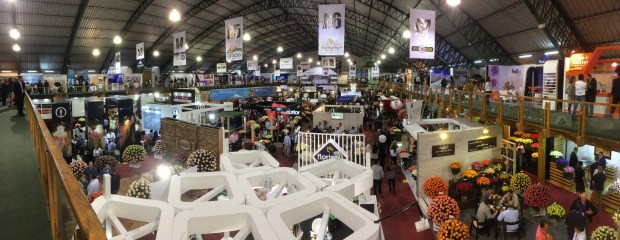
The first week I arrived in Quito was the Agriflor 2016 Cut Flower Show, where local and international floriculture industry meets in Quito every two years. This was the perfect chance to hit the ground running and connect with people in the industry.
Agriflor 2016
From October 17 – 20, 2016 I attended Habitat III, the United Nations Conference on Housing and Sustainable Urban Development, that took place right here in Quito. The New Urban Agenda was adopted at this conference, which only happens every 20 years. It gave me the opportunity to catch up with several friends and meet new ones from around the world that either study or work in urban issues, architecture, policy, gender and development topics. We all share passions on how we want to approach life and work. This was just the injection of inspiration and perspective that I needed in my first month here in Quito.
Heather & Sara
Quito Pavilion
Kirsten, Kristine, Heather, Sara, Caroline and Peter
Eli & Heather
New and old friends catching up!
Urbanists and architects enjoying Quito from the Teleferico
Julian Castro, US Secretary of Housing and Urban Development, speaking to the US Delegation
Quito Pavilion
October ended with our in-country Fulbright orientation. The first day was a full day of talks at the Sheraton Hotel in Quito covering topics from research in Ecuador, culture shock, US-Ecuador relations, gender issues, law and politics. We got to share lunch with the Ecuador Fulbright grantees that will be heading to universities in the US this coming year and Fulbright Ecuador board members. Day two we were treated to day at the Papallacta Thermal baths about 1.5 hours from Quito. The pictures speak for themselves of our relaxing day with the Fulbright grantees in Ecuador this year.
Orientation Day 1
Celebrating the 60 anniversary of Fulbright in Ecuador
Papallacta Hike
Papallacta Hike
Papallacta Hike
Papallacta Hike
Papallacta Thermal Baths
Papallacta Thermal Baths
Papallacta Thermal Baths
Photo by Emily
Photo by Fulbright Ecuador
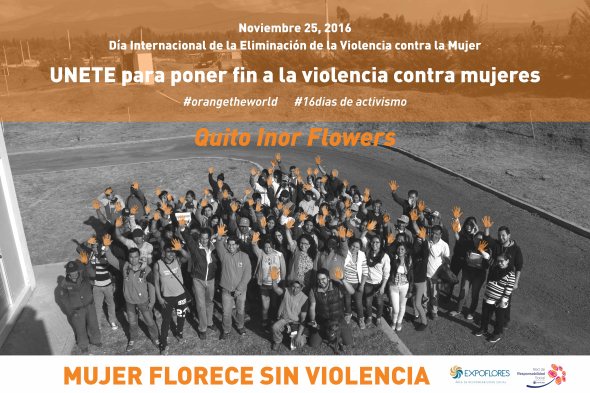
My volunteer time with the Area of Social Responsibility at Expoflores has also had its highlights. In November we worked on the UN Women UNITED Against Gender Violence as part of Expoflores “Women Bloom Without Violence,” the campaign of the Ecuadorean floriculture sector to eliminate violence against women. This was sixteen days of activism to Orange the World beginning with November 25th, the International Day for the Elimination of Violence against Women, and ending with Human Rights Day on December 10th. In December we participated in several Agasajos Navideños (Christmas Events) at farms with the children of employees. I can officially claim children’s face painting as a skill now!
Naranjo Roses
Floreloy
Sisapamba
Naranjo Roses
Naranjo Roses
Floreloy
Floreloy
Naranjo Roses
Sisapamba
Sisapamba
Sisapamba
Naranjo Roses
Floreloy
Naranjo Roses
Naranjo Roses
The unexpected gift of this experience has been getting to know the inspiring group of Fulbrighters that are here in Ecuador this year. Our group includes Fulbright US Student Researchers (like myself), Fulbright English Teaching Assistants, US Scholars and Fulbright-Hayes grantees, each with their own unique talents and fascinating projects. It is a blessing to have others that are going through similar experiences as your own to share with and learn from. The fact that they are also a great group of people makes for a lot of enjoyable social moments and exploring!
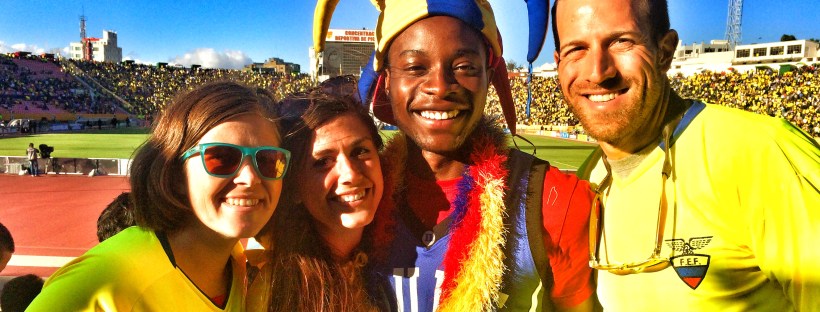
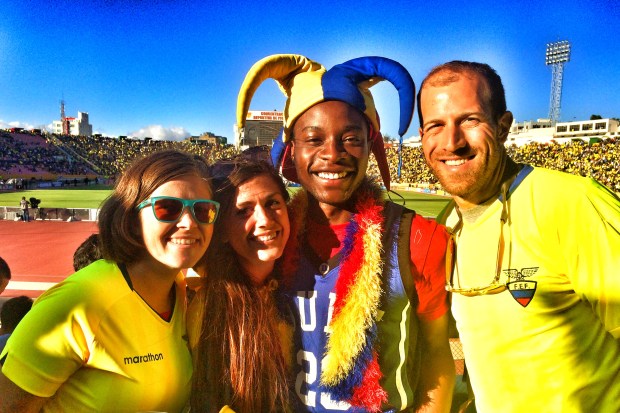
Heather, Emily, Okechi and Andy at the Ecuador vs Venezuela World Cup Qualifier soccer match. Ecuador won and we had a blast!









 Heather Ann Rule